Transport Answers
- The average speed is the total distance gone by the car divided by the time of the journey.
The instantaneous speed is the speed of the car at a particular instant in time on the journey.
Another way to picture this is to think of instantaneous speed as the reading on the speedometer of the car at a particular moment of the journey.
If I say that my average speed for my journey to school was 10m/s then its obvious that I wasn`t travelling at 10m/s for the whole journey. I might have stopped at traffic lights or even travelled a bit faster on a clear stretch of road.
- Use the formula distance = speed x time and just put in the numbers.
60 = s x 2.5
60/2.5 = s
so s = 24km/h
- Use the formula acceleration, that is a = change in speed / time taken.
Put in the numbers to get a = 60 / 4.5
This gives 13.3mph/s
Be careful with the units.
In part b) we use the knowledge that change in speed = acceleration x time.
So we get Change of speed = 5mph/s x 4 s = 20mph.
So the new speed = 25mph + 20mph = 45mph.
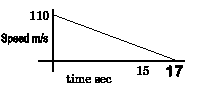
- a) accelearation = change in speed / time taken.
This gives a = -110 / 15
a = -7.33m/s2
The minus sign means that its speed is decreasing
ie the jet is decellerating.
So deceleration = 7.33m/s2
b) Distance gone is found from the area under the graph.
Area = 0.5 x 110 x 15
Distance gone = 825m.
c) Force = mass x acceleration, so F = 20,000kg x 7.33m/s2
= 146,600N
d) There is less friction acting on the plane and assuming that the reverse thrust
is kept the same this means the plane will take longer to stop. See diagram below.
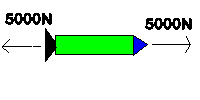
- The force of the thrust will be balanced by the force of air resistance as shown, assuming
that the rocket is travelling through air.
- Newton`s first law of motion states that an object will stay still or move with a constant speed unless an unbalanced force acts on it. So when you are sitting in a moving car you are travelling at the same speed as the moving car. If the car stops you continue to move forward at the same speed unless a seatbelt provides a force to stop you from moving forward.
- The unbalanced force = 2,500N. So using F = mass x acceleration
and sticking in the numbers we get 2,500 = 1,000 x a
so a = 2,500 / 1,000 = 2.5m/s2
- Weight = mass x gravitational field strength.
Weight = 15,000kg x 10N/kg
= 150,000N
- Kinetic energy = 0.5 x mass x speed 2
So sticking in the numbers gives 0.5 x 60 x 25= 750J
- Work done = Force x distance
Work done = 90N x 8m = 720J
b) Power = work done / time taken
Power = 720 / 12 = 60W
- In this problem first calculate the potential energy.
Ep = mass x gravity x height
Ep = 200 x 10 x 2.5
Ep = 5,000J
Now assuming that none of the energy is lost Ep = kinetic energy at the bottom.
So 5,000J = 0.5 x 200 x V2
5,000J / 100 = V2
50 = V2 and if we take the square root we get
V = 7.1m/s.
- First find out how much the mass weighs.
Weight = mass x gravitational field strength ( of the moon)
Weight = 10 x 1.66
Weight = 16.6N, this would be the minimum force.
Click on this switch  to return to the main page.
Click on this switch to go to the Physics Topic Questions Table
