Health Answers
- a) Place the thermometer in the patients mouth. Leave for a few minutes then take out and read the temperature. If the temperature is above or below the normal body temperature of 37C then the patient is unwell.
b) The scales are different; clinical thermometers have a temperature range of about 34C to 39C while a normal thermometer has a scale between -10C and 100C.
There is a special kink in the mercury thread just after the bulb at the bottom. This prevents the mercury contracting and going back into the bulb after the doctor has removed it from the patient.
Also the clinical thermometer has a triangular shaped which magnifies the scale allowing the scale to be easily seen.
- Use the equation v =
 x f. In this problem we get 1500 = x 3,000,000
rearranging gives 1500 / 3,000,000 = 0.0005m
x f. In this problem we get 1500 = x 3,000,000
rearranging gives 1500 / 3,000,000 = 0.0005m
- Exposure to any noise above 90dB for a length of time will result in hearing damage.
- a) Long sight, or to give the correct medical name Hypermetropia.
b) The diagrams below shows how the eye focuses near objects before and after correction.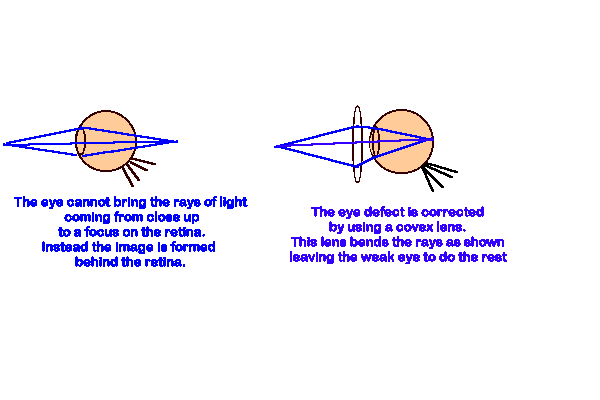
- The + sign shows a converging, or convex, lens.
Use the formula f = 1/power. This gives f = 1 / 2.5 = 0.4m.
Remember focal length must be metres!
- Alpha radiation is stopped by about 1cm of air or thin paper.
Beta radiation stopped by thin metal foil.
Gamma radiation is stopped by a few centimetres of lead.
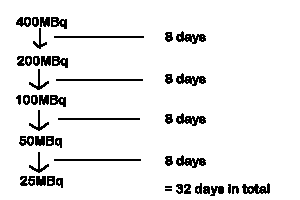
- a) The half-life of a radioactive substance is the time it takes for half of those radioactive atoms to become stable atoms.
b) The diagram below shows how to work out the activity 32 days later.
- Ionisation is the removal of one or more electrons from the cloud of electrons around the atom.
- The sievert is a unit that measures the dose of radiation that you receive if exposed to radiation.
The average dose received by a person in one year is 2.5millisieverts.
Click on this switch  to return to the main page.
Click on this switch to go to the Physics Topic Questions Table
