Electronics
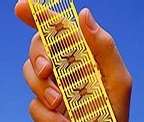 | The picture on the left shows a hand holding three microchips. |
- Linda has bought a new computer.
She can`t tell how all the computer works but she can split it up into three system blocks.
a) What are the three system blocks called?
b) Name the parts of the computer that these three systems would describe?
- Jack works as a technician at the BBC. His job is to examine signals. The diagrams below show three such signals.
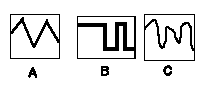
Which signals are digital and which are analogue?
- What are the energy changes involved in a solenoid, an LED, buzzer and a relay.
- Robert & Sally have built this circuit. Sally looks up a data book and finds that the thermistor has a resistance 2k ohms when the temperature is 28 degrees.
Calculate the current flowing in the circuit at this temperature.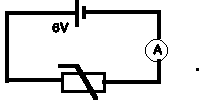
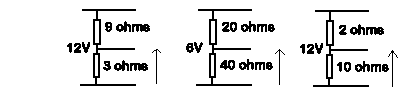
- Calculate the output voltage in these voltage dividers:
- When a capacitor is charged up what happens to the voltage across it?
- Sharon is studying Electronics at the University. She has built this circuit:
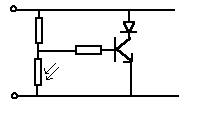
a) What happpens to the voltage across the light dependent resistor when it becomes dark?
b) Describe what happens to the transistor when the light level becomes dark?
c) Why is there a resistor in series with the transistor?
- Sharon builds another circuit shown below:
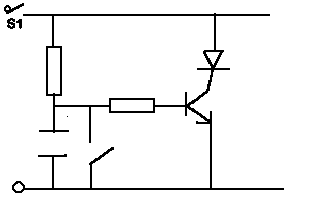
Explain why the diode takes its time to come on when switch S1 is switched on.
Describe a use for this circuit.
- Ian & Yasmin have been given the job of identifying a logic gate.
From the logic table, they drew up, identify the logic gate.
A B Output 0 0 0 0 1 1 1 0 1 1 1 1
- A stereo cassette player has a magnetic head that picks up a voltge of 0.5mV from the tape. This is amplified to 0.5V.
a) Calculate the voltage gain of the amplifier.
b) If the output power is 10W for one speaker then calculate the resistance of the speaker.
Click on this switch  to return to the main page.
Click on this switch to go to the Physics Topic Questions Table
